VFFS Hopper Clogging: 10 Causes and Field Fixes
When a VFFS机 stops filling correctly, operators usually blame the sealing jaws. In most powder and granule plants the real problem sits one level higher: the hopper. A hopper clogs for one of three reasons — the material has bridged over the outlet, it has rat-holed into a stable funnel with a dead ring around the wall, or the blockage is not in the hopper at all but in the auger, feeder, or elevator supplying it. Each has a different fix, and applying the wrong one costs you the whole shift.
Below is the diagnostic sequence our commissioning engineers use on site, including the field data we recorded at a Sri Lankan sugar repackaging plant where hopper blockages dropped from two per day to zero.
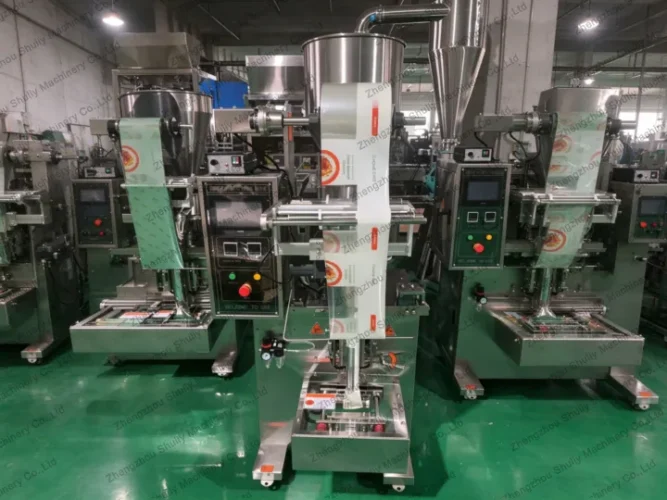
Identify Which Failure You Actually Have
Do not open the hopper first. Stand back for sixty seconds and watch the bag weights on the discharge conveyor — the pattern of the underfilled bags tells you the failure type before you touch anything.
| Symptom on the line | What is actually happening | First check (under 2 minutes) |
|---|---|---|
| Flow stops suddenly, hopper still half full, level does not drop | Bridging — an arch of material spans the outlet | Tap the hopper cone with a rubber mallet. If it collapses and flow resumes, it is a bridge |
| Level drops only in the centre, product at the walls stays still | Rat-holing — funnel flow with a stagnant ring | Look down the fill neck: a vertical column with a mountain of untouched product around it |
| Bags drift lighter as the hopper empties, then recover after a refill | Compaction and de-aeration of a fine powder | Compare the same recipe at a full hopper and at a nearly empty one |
| Intermittent starvation, hopper outlet visibly clear | Feeder, auger, or elevator jam upstream | Stop the feeder and inspect the screw and the elevator inlets |
| Every bag light, hopper outlet wet or crusted | Moisture clumping at the outlet | Touch the outlet plate and the product around it; check room humidity |
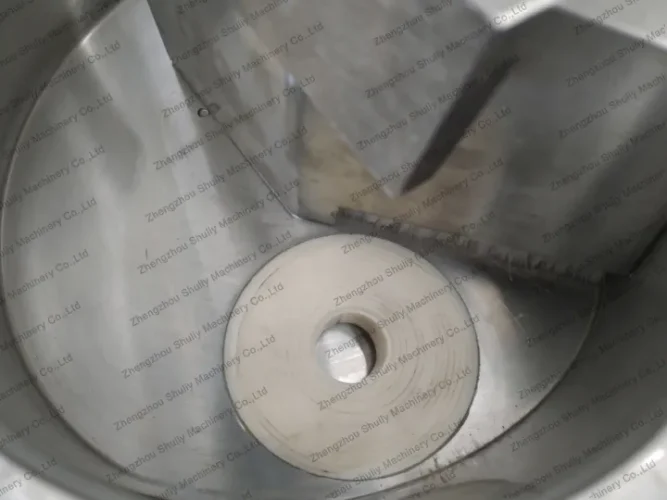
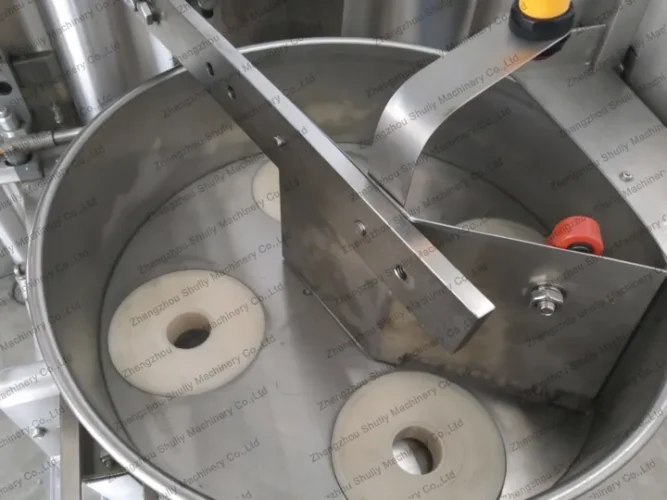
The Four Physical Mechanisms Behind Every Blockage
Field troubleshooting works when you know why the material behaves the way it does. Four mechanisms produce almost all hopper problems we are called to fix:
- Particle cohesion — moisture, oil, or fine fines create liquid bridges and van der Waals attraction between particles. A humid monsoon room can turn free-flowing white sugar into a clumping solid without you changing a single machine setting.
- Compaction and air entrapment — the deeper the product column, the more pressure on the outlet. Powders such as milk powder, flour, and ground coffee trap air and behave like a fluid that will not drain; this is why bulk density changes with the head of product.
- Wall friction and static — a dry winter plant with low humidity lets charged film and powder cling to stainless surfaces and to the film web, drawing product out of the intended path.
- Geometry and feed-rate mismatch — an outlet too small for the particle size, a cone that is too shallow, or a dosing device that moves more material than the hopper can deliver. As a rule, the outlet must be several times the largest particle diameter; a 2 mm particle will not flow reliably through a narrow, poorly radiused outlet.
These are the same product properties we cover in 3 features of your powder products — fluidity, particle size, bulk density, and moisture — and they decide which powder packing machine and filling method you need in the first place.
Reference: What a Healthy Granule Line Looks Like

Watch the feed column in this 颗粒包装机 running sugar, tea, and detergent powder. Free-flowing granules pass the forming shoulder and the dosing device with a steady, even surface. When your own line loses that even surface — ripples, a funnel in the middle, or a hopper that empties unevenly — you already know which of the ten causes below to open first. If you are unsure which dosing device your machine uses, the working principle of a sugar sachet packing machine walks through the measuring-cup path step by step.
10 VFFS Hopper Clogging Problems and How to Fix Each One
1. Bridging Over the Outlet
Symptom: the level stops dropping while the hopper is still half full; bags go empty in bursts after each collapse.
Fix: restore flow mechanically first — a few firm taps on the cone with a rubber mallet, never a hammer on the weld line. If a bridge reforms within minutes, the root cause is the material, not the operator: the cohesion is too high for that outlet geometry, so you need stirring, a steeper flow path, or an active feeder rather than gravity. Re-tapping every ten minutes is downtime you are paying for in lost output.
2. Rat-Holing (Funnel Flow With a Stagnant Ring)
Symptom: a vertical column of moving product directly above the outlet while material against the walls stays untouched for hours. Why it matters beyond flow: the stagnant ring does not just waste capacity — it ages. In food plants the ring dries out or warms to room temperature, so the fresh product in the column no longer matches the old product that eventually falls in, and weights and appearance drift.
Fix: batch-refill instead of running the hopper to empty, so the ring never gets time to set; for sticky or oily products, move to a hopper that sweeps the walls. Mixed granules that must not separate are the classic case for a chain bucket (tipping bucket) machine instead of a gravity hopper: each bag is filled by an individual bucket, so there is no funnel to bridge at all.
3. Compaction and Air Entrapment in Fine Powders
Symptom: weights drift lighter as the head of product falls, then jump back after a refill — the sign of a 粉末包装机 dosing aerated flour, milk powder, or spice powder.
Fix: keep the hopper in a narrow operating band (refill before the level drops too low), and de-aerate hygroscopic, airy powders before they reach the dosing device. Note that the opposite error is equally damaging: over-aerating a dense powder destroys its natural flow. There is no single correct aeration level, which is exactly why we test your actual material in our workshop before recommending a dosing system.
4. Moisture Clumping in Humid Seasons
This is the cause we see most often in South and South-East Asian plants, and it is the one with hard numbers attached to it. A family-owned sugar repackaging business in Sri Lanka runs in a tropical climate of 75–85% relative humidity at 28–32 °C. Before automation, ambient humidity caused the sugar to clump inside the hopper and block the manual funnel twice a day, every day from May to September.
After they installed the 200 model sugar packing machine, whose 304 stainless steel contact parts kept running through the monsoon without caking, the recorded hopper blockages during the 2026 monsoon fell to zero, while fill accuracy improved from ±0.5 g to ±0.2 g and defect rate from 2.3% to 0.4%. The full delivery record is in our Sri Lanka sugar case study.
Fix pattern for hygroscopic products (sugar, salt, milk powder, detergent, citric acid): control the environment as well as the machine — dehumidify the packing room, keep bulk sacks closed next to the hopper, choose stainless over painted steel, and prefer an auger or a stirred flow path over a bare gravity cone. Our New Zealand powder line uses the same principle with a vacuum feeder: the product reaches the hopper through a closed hose instead of an open funnel.
5. An Outlet Too Small for the Particle Size
Symptom: the hopper flows on Monday and clogs on Tuesday after you changed from fine granules to coarse ones.
Fix: check the largest dimension of the product against the outlet, and look at the transition under the outlet — a sharp right-angle corner is a bridge anchor, while a radiused flow path is not. When the changeover was made by swapping the forming shoulder only, the dosing device and the outlet were never re-matched to the new particle size — how an automatic granule packing machine works shows which parts have to change together. This is the most common self-inflicted clogging event on multi-product lines.
6. The Wrong Hopper Type for the Material
Operators treat “the hopper” as one part. It is a design decision, and the wrong decision produces a blockage no maintenance schedule will ever fix. Our own equipment pages are explicit about it: for pastes carrying particles, a U-type hopper on a 膏体包装机 is the right choice, and if the material is viscous you add a heating and stirring device to make it fill at all. A customer in the Philippines peanut butter project needed precisely that stirring function to keep the product moving smoothly; a buyer in Singapore specified stirring on a chili sauce paste line to prevent stratification during packing.


7. Auger and Screw Dosing Mismatch
On a screw-dosed powder machine the clog usually moves inside the screw tube rather than the hopper. Three signatures separate it from a hopper bridge: the screw keeps turning but nothing arrives; the motor current or sound changes; and powder packs into the tube after a stop, hardening into a plug.
- Product on the wrong screw — a screw cut for a light spice powder will pack and stall with a dense detergent powder. Matching the screw to the fluidity, particle size, and humidity of the product is the first selection rule for powder equipment, not a fine-tuning step.
- Empty-run and low-level stalls — running the hopper below the screw inlet lets air into the tube and the dose collapses. On the 1–3 kg automatic powder packing machine the screw pushes powder straight into the bag through a closed filling structure, so an air pocket shows up immediately as both a weight error and a dust leak at the seal.
- Stop-time consolidation — every long stop lets the powder settle into the screw clearance. Train operators to run the screw briefly before closing a break rather than leaving the product stationary in the tube.
8. The Blockage Is in the Feeder, Not the Hopper
When the machine is fed from a bulk container, most “hopper clogs” are really supply failures upstream. An Australian cement producer we supplied runs a semi-automatic system in which the packing machine has a 90 L working hopper, while a separate 150 L screw feeder hopper (880 × 820 × 850 mm, 114 mm pipe, 1.5 kW) lifts ground-level cement into it. That feeder hopper is what keeps the supply uninterrupted between batches — and it is the first place a cement line stalls, because cement is dusty, abrasive, and moisture-sensitive.
Check the three feeding routes by type:
- 螺旋输送机 — the screw carries material into the machine hopper under its own motor. Test for a jammed bend, a bridge above the intake, and a buried intake (the conveyor must not be starved or flooded).
- Vacuum elevator — inspect the hose for a packed elbow, the filter for blinding, and the vacuum level for a drop; a partially blocked line starves the hopper slowly and reads as a “light bag” fault.
- Z-type bucket elevator — residual product in the boot is the usual culprit, with buckets carrying hardened leftovers back into the flow. On lines that feed a weigher this matters twice over: in the popcorn packing setup we describe elsewhere, the worker pours product into a vibrating feeder and the Z-type elevator lifts it to the combination scale, so a dirty boot contaminates every next batch. On the multihead weigher itself the top cone and feed pan must keep vibrating to move product gently into the weighing buckets — if they stall, the buckets starve and bag weights drop.


9. Dust Escaping Into the Seal Area
Loose dust is a clogging symptom with a downstream penalty: powder leaking around the filling chute coats the film and the jaws, and the seals then fail. We build against it deliberately — the 1–3 kg machine uses a closed filling structure that seals without dust and without powder fouling the seam, and the cement line carries a centrifugal fan with dust-removal ducting to pull airborne powder away from the filling zone.
Fix on your own line: if the jaws are the dirty part of the machine, the hopper is feeding too fast or the chute is not sealed; reduce the discharge rate, check the filling chute gasket, and clean the seal jaws on a schedule rather than at every stop.
10. Static Attraction and Changeover Residue
In dry winter plants, charged film and powder cling to the hopper lip, the measuring cup, and the film web, pulling product out of the intended path and starting a bridge at a place that looks dry and clean. Ground the machine frame, raise the room humidity slightly, and pass an antistatic bar over the forming area before blaming the dosing system. The second cause is time-shifted: residue from a previous product hardens in the corner of the hopper or in the screw tube, then breaks loose during the next run. This is why our powder filling machines use a modular, quick and easy to clean design, and why a 洗衣粉包装机 changeover checklist must include the hopper interior and the screw, not only the forming shoulder.

Match the Hopper and the Dosing System to the Material
If two of the ten fixes above keep coming back on the same product, the machine was matched to a bag size rather than to the material. Use this table as the design-level answer.
| Material behaviour | Hopper and feeding choice | Why it stops the clog |
|---|---|---|
| Free-flowing dry granules (sugar, rice, salt, seeds, candy) | Gravity hopper with volumetric cups or a multihead weigher | No compaction zone; the product needs a clear path, not agitation |
| Non-stick mixed granules that must not separate (snacks, popcorn, nuts) | Chain bucket / tipping bucket hopper | Each bag is dosed by its own bucket, so no funnel can bridge |
| Airy or hygroscopic fine powders (flour, milk powder, spices, detergent) | Screw (auger) dosing with a stirred or actively fed hopper | The screw carries the compacted layer out instead of waiting for gravity |
| Viscous paste, or paste carrying small particles | U-type hopper with stirring, plus heating when viscosity is high | Walls are swept and stratification is prevented |
| Dusty, abrasive minerals (cement, charcoal powder, filler powders) | Large working hopper fed by a screw feeder hopper, with dust extraction | Supply stays continuous and dust is pulled out of the seal zone |
| Stick packs and narrow sachets | Compact or square hopper matched to the stick-former | Short flow path means less column pressure and less chance of a bridge |
A 20-Minute Downtime Triage Sequence
- Record the bag-weight pattern and the hopper level before you clear anything — the sequence is the diagnosis.
- Tap the cone with a rubber mallet. Flow returns: you have a bridge, continue to step 5. Nothing changes: check the outlet.
- Open the access door and look at the outlet plate for a wet or crusted layer, a foreign object, or a film tail that has been drawn into the flow.
- If the outlet is clear, stop the machine and inspect upstream — screw tube, elevator boot, vacuum hose elbow, and the feeder intake.
- Test the material by hand: take a handful from the hopper. It should break apart with light pressure. If it holds a shape, cohesion is the root cause, not geometry.
- Check the room, not just the machine: relative humidity, an open bulk sack next to the hopper, and a cold machine surface condensing overnight.
- Restart at reduced speed and watch the level fall evenly across the whole cross-section. Uneven fall means funnel flow, so plan the refill band.
- Log what you cleared and what the product felt like. The third recurrence of the same cause is a design problem, and it needs a change of hopper or dosing system rather than more maintenance.
Preventive Maintenance Intervals
| Interval | Check | What it prevents |
|---|---|---|
| Every shift | Wipe the outlet plate and filling chute; confirm no crusted product at the mouth | Moisture plugs and dust falling into the seal jaws |
| Every shift | Keep the hopper inside its refill band; never let it run dry below the screw inlet | Air entering the screw tube and weight drift |
| Daily | Run the screw briefly before a long stop, and again before restart | Consolidated plugs forming during breaks |
| Weekly | Inspect hopper interior, weld corners, and gaskets; check grounding and antistatic devices | Bridge anchors and static-built deposits |
| Every product change | Clear the hopper, the dosing device, and the feeder/elevator boot; re-match cup or screw to the new particle size | Changeover residue and self-inflicted clogging |
| Monthly | Check the dust fan, filter, and ducting on powder and mineral lines | Starved vacuum feed and dust-covered seals |
When the Root Cause Is Not in the Hopper
Two faults imitate a clogged hopper. The first is a film-tracking problem: if the photoelectric eye loses the colour mark, bags are made at the wrong length and the weights look wrong even though the product flowed normally. The second is a sealing problem — powder on the jaws or a cold seal gives reject bags that operators report as “filling faults”. Read the working principle of a VFFS machine and confirm the sequence of forming, filling, and sealing before you take the hopper apart.
Frequently Asked Questions
How do I know whether my hopper is bridging or rat-holing?
Bridging stops the hopper level from falling at all while the hopper is still partly full, and a firm tap on the cone collapses the arch and resumes flow. Rat-holing keeps a central column moving while product against the walls stays untouched, so the level drops in the middle only. Rat-holing needs a refill band or a swept hopper; bridging needs cohesion or geometry fixed.
Why does my sugar or salt hopper clog only in the rainy season?
Because humidity, not the machine, changed. Free moisture creates liquid bridges between crystals, so a product that flows in dry air clumps inside the hopper in humid air. A Sri Lankan sugar plant recorded two hopper blockages per day through the May to September monsoon before automation. Dehumidify the room, keep bulk sacks closed, use stainless contact parts, and feed with a screw instead of an open gravity funnel.
Can I fit a vibrator to the hopper to stop clogging?
Only as a last step. Vibration consolidates many powders, so it can make bridging worse and can damage welds and thin hoppers over time. It also separates blended granules. Fix outlet size, hopper type, and product moisture first, then consider assisted flow with the dosing device doing the work.
My bags get lighter as the hopper empties. Is the hopper clogged?
Not clogged — compacted and aerated. The deeper column of powder compresses the layer at the outlet and traps air, so the dose density changes with the head of product. Keep the level inside a narrow refill band, de-aerate airy powders, and for accurate dosing of a compacting powder use screw dosing or weigher feeding rather than a volumetric cup.
What is the first part to check when a powder packing machine starves?
Check the feeding route before the hopper: the screw tube for a packed section, the vacuum elevator hose elbow and filter, and the bucket elevator boot for hardened leftovers. A hopper rarely fails on its own when a feeder is involved, which is why larger powder lines carry a separate feeder hopper, for example a 150 liter screw feeder hopper feeding the packing machine working hopper.
Send Us the Material, Not the Symptom
Hopper clogging is a material problem wearing a machine costume. That is why we ask customers to ship a sample of the actual product — with its current moisture and its real particle size — before we specify a hopper and a dosing system. In our workshop we run it on the candidate machine, watch where the flow column breaks, and only then confirm the configuration, the packaging-speed video, and the CIF quotation.
电子邮件 sales@tianhuipackingmachine.com or contact us on WhatsApp +86-13673689272 with the product name, target bag weight, and the season or humidity of your packing room. If you are choosing the equipment in the first place, start with how to choose a suitable powder packing machine 和 粉末包装机 family page.
